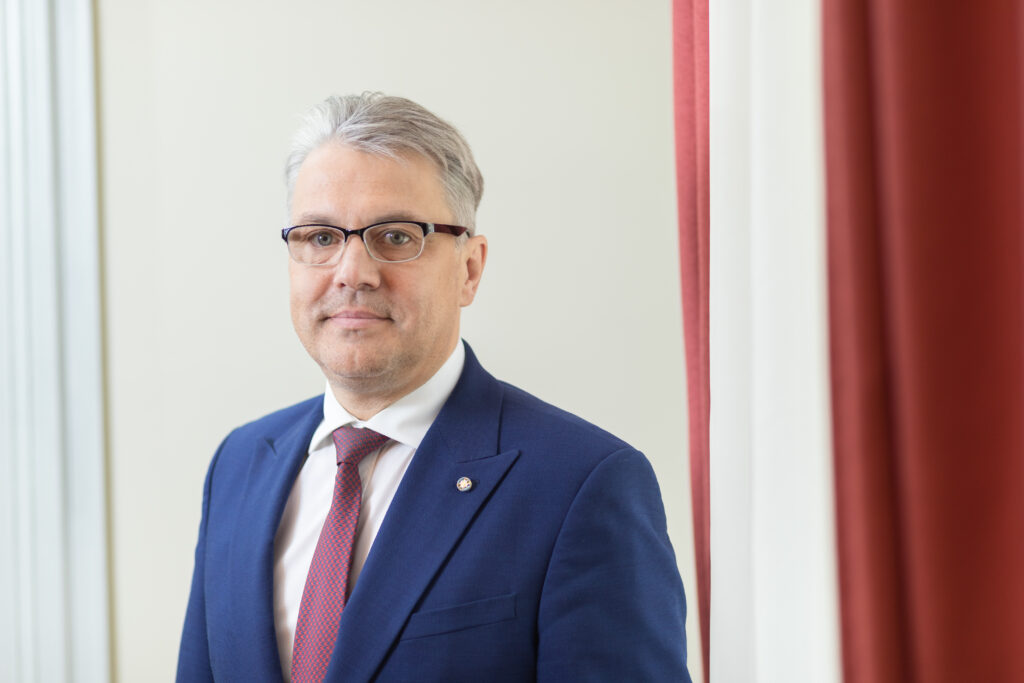
The Ombudsman of the Republic of Latvia is an official elected by the Parliament, whose main tasks are encouragement of the protection of human rights and promotion of a legal and expedient State authority, which observes the principle of good administration.
The Ombudsman is independent in its actions and is governed only by law. No persons or State or municipal institutions have the right to influence the performance of the Ombudsman’s functions and tasks.
Citizens of Latvia, who are at least 30 years of age, have an impeccable reputation, higher education, knowledge and hands-on experience in the protection of rights and eligible by law to access State secrets, may be approved in the position of Ombudsman. The Ombudsman is elected for five years and assumes his or her duties after taking an oath.
On 1 March 2007 Mr.Romāns Apsītis – a lawyer, Doctor of Laws, a tutor of many years’ standing at the University of Latvia, State and public official (including the posts of Minister for Justice and judge of the Constitutional court), was elected as the first Ombudsman of the Republic of Latvia.
Since 17 March 2011 Mr.Juris Jansons is the Ombudsman of the Republic of Latvia.
Functions of the Ombudsman
The activities of an Ombudsman are regulated by the Ombudsman Law, which was adopted on 6 April 2006 and came into force on 1 January 2007. It defines several functions of this official:
1) The Ombudsman acts to protect the rights and legal interests of a person in situations when State and municipal authorities have breached the human rights defined by the Constitution and international human rights’ documents. Some of the key human rights are the rights to a fair, free and timely trial, freedom of speech and expression, private life, housing, social security, employment, property, these and other rights related to the interests of children, the rights of persons with special needs, etc.
2) The Ombudsman works to ensure equal treatment and prevention of discrimination. For example, the Ombudsman addresses issues regarding discrimination on the grounds of nationality, religion, social background, material or health conditions, sexual orientation, political or other views, etc. Furthermore, the Ombudsman can deal with complaints in case of discrimination or breach of the principle of equal treatment not only by State authorities, but also by private individuals or legal entities.
In cases, when a breach of the principle of equal treatment is detected, the Ombudsman is entitled to prepare an application on behalf of the person and to represent the person in hearings of civil cases in court.
3) The Ombudsman evaluates and promotes adherence to the principle of good administration in government. Good administration implies unprejudiced and honest decision-making within reasonable time limits, the right of a person to be heard, to get acquainted with case materials, to request a justified decision, compensation of damages, etc.
Persons may apply to the Ombudsman with a complaint or request in regard to all the aforementioned matters and demand prevention of the violation of rights. If a breach is detected, and if it is necessary for the benefit of society, the Ombudsman may represent the rights and interests of a private individual also in an administrative court.
4) The Ombudsman reveals imperfections in regulations and application thereof connected with adherence to human rights and works to eliminate such imperfections. For example, the Ombudsman is entitled to submit reports on certain matters to the Parliament, State President, Cabinet of Ministers, State authorities and international organisations or to file an application for bringing a case to the Constitutional Court, if the authority, which has passed the debatable regulation, has not eliminated the imperfections within the specified time period.
5) The Ombudsman works to enhance the public awareness of human rights, the mechanisms of protection of these rights and the work of the Ombudsman. Once a year, the Ombudsman prepares a written report on the work of the Ombudsman Office, elaborates and distributes information on human rights and the principle of good administration guaranteed by the law and international commitments of Latvia, stages seminars and conferences, informs the mass-media, etc.